
Branches scraping your roof. Dead limbs hanging over your yard. Oak trees that need trimming before the Wisconsin DNR window closes to stop oak wilt. Whatever your trees need, Tree Removal Milwaukee Co handles it safely and at a price written down before any cut is made. We serve homeowners and businesses across all of Milwaukee County.
We trim every species. We follow ISA pruning standards. We haul all debris away.
 Reviews from Our Customers
 A bad cut on an oak during the wrong season opens a direct pathway for oak wilt that can kill the tree within weeks. A silver maple trimmed without understanding its crown structure creates a co-dominant union that splits under the first heavy ice storm. Tree trimming done wrong does not just hurt the tree. It creates a hazard, accelerates decay, and costs far more to fix than a proper job would have cost in the first place.
Milwaukee trees face threats most trimming crews are not trained to handle. The Wisconsin DNR restricts oak pruning between April 1 and July 15 because bark beetles carrying Ceratocystis fagacearum, the oak wilt fungus, are actively flying during those months and are drawn to fresh wounds. Silver maples are the most common tree in residential yards across Milwaukee County and among the most structurally unpredictable, developing wide co-dominant stems that split under ice load from Lake Michigan storms. Emerald Ash Borer has weakened ash trees across the city in ways that make crown work dangerous without a proper species assessment first.
The ISA Certified Arborists at Tree Removal Milwaukee Co. follow ANSI A300 pruning standards on every job. The team identifies the correct cut point for each branch, makes every cut just outside the branch collar, and follows the DNR oak wilt window without exception. Trees are never topped. Topping destroys branch architecture, creates large decay wounds, and produces regrowth that fails faster in storms than the original crown. Crown reduction is the correct approach and the only one performed by Tree Removal Milwaukee Co.
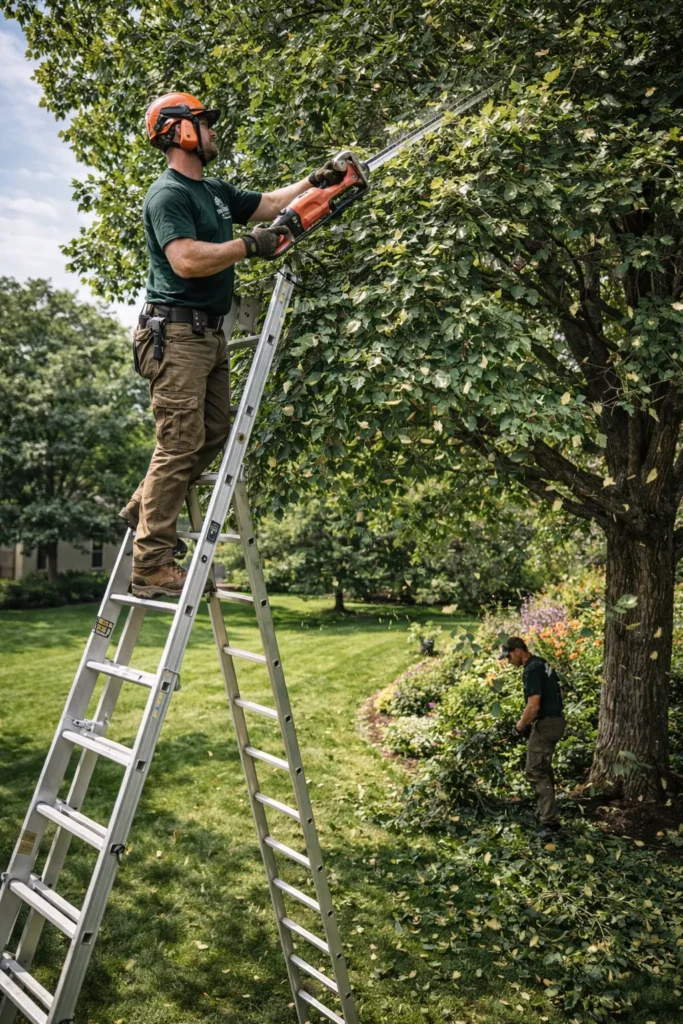
No surprises. Here is exactly what happens when you call us for tree trimming.
We visit your property, examine every tree, and give you a written estimate at no charge. Our ISA Certified Arborists check species, crown structure, deadwood, and proximity to your roof and power lines. For oaks, we verify the Wisconsin DNR seasonal window before scheduling any work.
We identify the right approach for each tree before any cut is made. Crown clean, crown reduction, or crown raising, each follows ANSI A300 pruning standards. We never top trees. Topping destroys branch structure and creates decay entry points that shorten the tree’s life
We use climbing gear, aerial lifts, and bucket trucks to reach every part of your tree safely. Every cut is made just outside the branch collar to promote wound closure. If a tree is near utility lines, we follow We Energies safe approach distance protocols before climbing
We chip all branches on site, haul every bit of debris away, rake beneath the tree, and blow clippings off your driveway and walkways. We walk the site with you before loading equipment. Nothing is left behind unless you ask for garden mulch.
We handle every tree trimming situation common to Milwaukee County. Here are the jobs we handle most.
Dead branches do not fall on a schedule. EAB-damaged ash trees are especially unpredictable because the wood becomes brittle as borer damage progresses. Our ISA Certified Arborists remove deadwood from the crown outward, cutting just outside the branch collar. We identify and remove widow makers, hanging or partially attached dead branches that are the most immediate hazard in any yard
Crown reduction cuts branches back to strong lateral growth points while preserving the tree’s natural shape. It is the correct approach for a silver maple or Norway maple that has outgrown the space above your roof. Crown cleaning removes crossing and rubbing branches to improve structure and airflow. Both follow ANSI A300 standards and are performed by our ISA Certified Arborists
The Wisconsin DNR advises against pruning oaks between April 1 and July 15 each year. During that window, bark beetles carrying Ceratocystis fagacearum, the oak wilt fungus, are actively moving between trees and are attracted to fresh wounds. We schedule oak work before April 1 or after mid-July. For emergency cuts during the restricted window, we apply wound sealant to every cut surface. Most crews in the area skip this entirely.
Trees growing toward power lines are the homeowner’s responsibility. We Energies maintains its own lines, but private property trees are yours to manage. We follow safe approach distance protocols for all work near energized lines and do not cut branches touching live lines without proper coordination. If your tree is already in contact with distribution lines, we assess the situation before any climbing begins.
Spring derechos snap major branches without fully detaching them. Summer thunderstorms split co-dominant silver maple unions and leave half the crown hanging. Fall ice storms from Lake Michigan load branches past their breaking point overnight. A partially broken branch, called a hangar, can drop without any additional wind. We respond to storm damage trimming calls 24 hours a day, 7 days a week across the county.
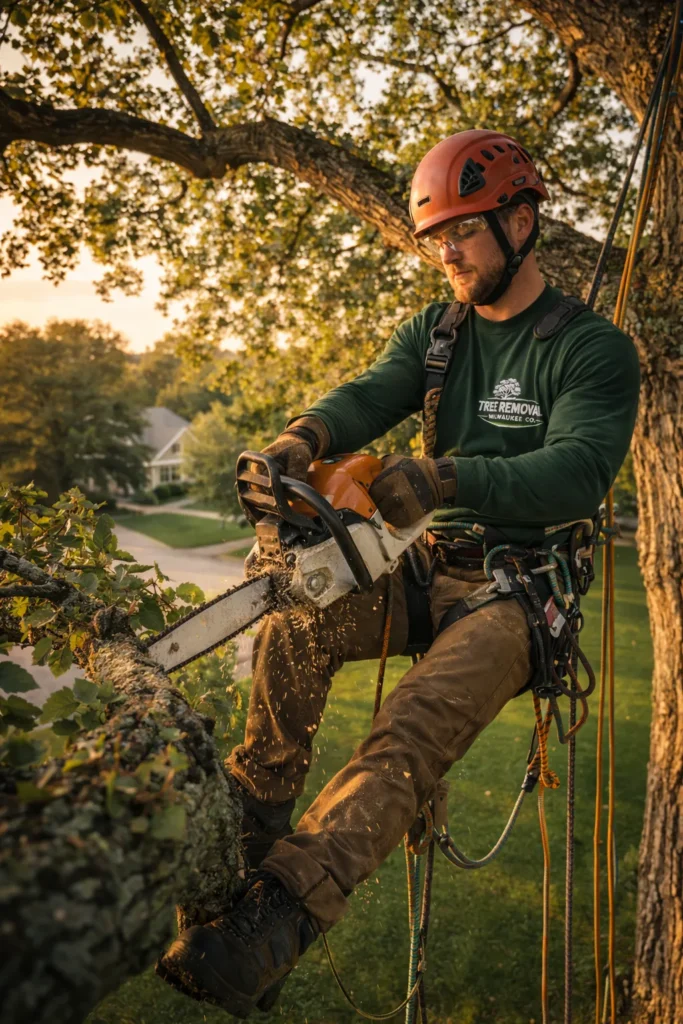
There are plenty of trimming crews across the county. Here is what makes homeowners call us back.
ISA Certified Arborists on every job. We follow ANSI A300 pruning standards, respect the DNR oak wilt window, and make every cut at the correct branch collar location. Proper pruning extends tree life. We do it right on every job.
Transparent pricing. Single tree trimming in Milwaukee runs $275 to $650 for most jobs. Large mature trees with crown reduction needs can run $650 to $1,200. We charge by the job. The number on your written estimate is the number on your invoice.
Equipment for every situation. Climbing gear, aerial lifts, and bucket trucks for any tree. Insulated tools and We Energies safe approach protocols for work near power lines. We do not put our crew in unsafe situations.
Complete debris removal on every job. We chip all branches, haul everything away, and blow your driveway clean before we leave. No brush piles left behind unless you ask for garden mulch.
Silver maple, box elder, and Norway maple all develop structural weaknesses that cause branch failure in storms. Regular trimming by an ISA Certified Arborist removes those weaknesses before they become emergency calls. One trimming visit costs a fraction of emergency removal after a branch lands on your roof.
Removing deadwood eliminates entry points for fungal decay. Better crown airflow reduces disease conditions. For ash trees under EAB pressure, targeted deadwood removal can extend the tree’s life while you weigh treatment options. For oaks trimmed within the DNR window, proper wound closure stops oak wilt at cut sites.
Overgrown branches scrape roof shingles, clog gutters, and block sunlight from your lawn. Crown raising opens clearance over driveways and walkways. Crown cleaning restores the natural shape of mature trees. A well-maintained oak or silver maple adds visible value to any Milwaukee County property.
In Wisconsin, property owners are responsible for hazardous conditions on their land. A dead branch over your sidewalk that drops and injures someone puts you on the hook. Regular trimming by an ISA Certified Arborist identifies and removes these hazards before they cause an incident.
Most jobs fall between $275 and $650 depending on tree size, species, and access. A small tree under 25 feet typically costs $275 to $400. A large mature oak or silver maple with crown reduction work can run $650 to $1,200. Trees near power lines or structures cost more because of the extra precaution required. We charge by the job so your total is fixed before we start.
Late winter, from January through mid-March, is ideal for most species. Trees are dormant, the crown structure is easy to see without leaves, and insects that spread disease are inactive. For oaks, the Wisconsin DNR advises against pruning between April 1 and July 15 because of oak wilt beetle activity. For all other species, trimming can be done year round, though late winter produces the best results for structural work.
Yes. The Wisconsin DNR advises against pruning oaks between April 1 and July 15. During that window, bark beetles carrying Ceratocystis fagacearum, the fungus that causes oak wilt, are actively moving and are attracted to fresh wounds. Oak wilt can kill a red oak within a single growing season. For planned oak work, we schedule before April 1 or after mid-July. For emergency cuts during the window, we apply wound sealant to every cut surface.
Topping means cutting main branches back to stubs to reduce height quickly. No ISA Certified Arborist recommends it. Topping removes most of the tree’s leaf-bearing canopy, starving it of the energy needed to close wounds. The large stubs decay from the inside out. New regrowth is weakly attached and breaks off easier in storms than the original branches. The correct approach is crown reduction, which cuts back to healthy lateral growth while preserving the tree’s structure.
Trimming means cutting back overgrown branches to manage size, shape, and clearance. Pruning means selectively removing specific branches for tree health, including deadwood, crossing branches, and disease prevention cuts. In practice, most jobs involve both. Our ISA Certified Arborists assess your trees and perform whichever combination serves both tree health and property safety in a single visit.